We use two different 3D printing methods because one machine can’t be best at everything.
How They’re Made
Resin Printing (SLA / MSLA)
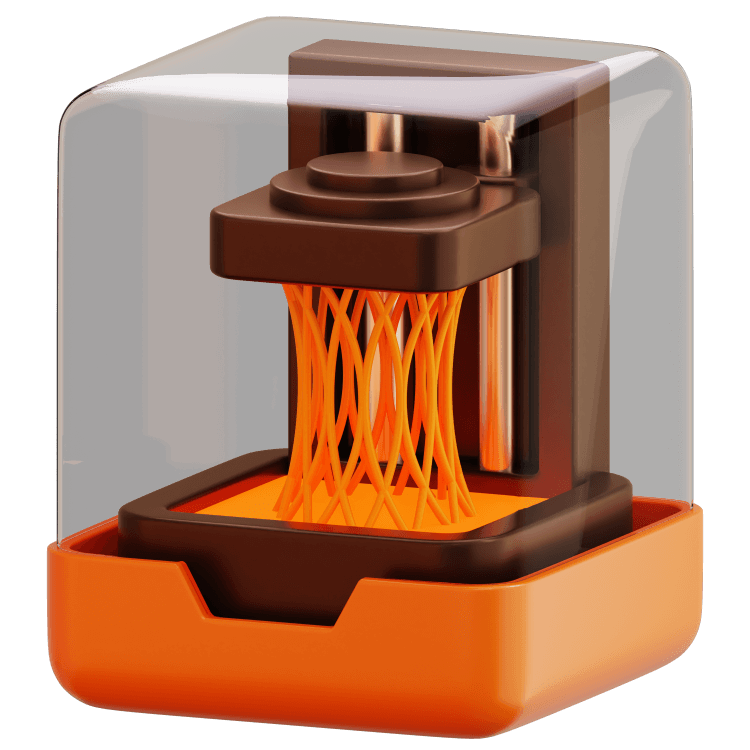
Resin printing uses liquid photopolymer resin and UV light. Instead of drawing melted plastic line-by-line, the printer cures an entire layer at once – which is why faces, filigree, and spell effects come out crisp.
How It Works
- The build plate lowers into a vat of liquid resin.
- A UV screen projects a masked layer, curing resin into shape.
- The plate lifts so fresh resin flows underneath.
- Repeat layer-by-layer until the part is complete.
- Wash and UV cure for a fully hardened part
Best At
- Ultra-fine detail (faces, textures, tiny accessories)
- Smooth surfaces
- Organic shapes
- Translucent spell effects
- Miniatures (28-35mm and up) and display pieces
Weak At
- Impact resistance (thin parts can snap if dropped)
- Very large, load-bearing structural pieces
- More finishing steps (wash + cure)
Filament Printing (FDM)
Filament printing melts thermoplastic (like PLA or PETG) and lays it down line-by-line. It’s durable, scalable, and ideal for big
terrain, organizers, and functional parts.
How It Works
- Filament feeds into a heated nozzle and melts.
- The nozzle draws the part, laying down plastic layer-by-layer.
- Each layer stacks until the model is complete.
- Cleanup is usually minimal; sanding/priming improves finish.
Best At
- Large terrain and stadium pieces
- Durability and impact resistance
- Cost-efficient larger prints
- Functional parts and organizers/inserts
Weak At
- Very fine miniature detail (faces soften)
- Visible layer lines (improves with priming/paint)
- Small minis can look “rough” without finishing
Quick Comparison
| Feature | Resin (SLA/MSLA) | Filament (FDM) |
|---|---|---|
| Detail | Extremely high (faces, textures, filigree) | Moderate (fine detail softens) |
| Surface finish | Smooth, crisp edges | Layer lines visible (improves with sanding/primer) |
| Strength | Rigid; can be brittle under impact | Durable; better impact resistance |
| Best for | Miniatures, spell effects, detailed parts | Terrain, inserts, large functional prints |
| Print method | Cures entire layers with UV light | Draws lines of melted plastic |
| Post-processing | Wash + UV cure | Usually minimal; optional finishing |
How we choose:
- Miniatures = resin.
- Big terrain/functional = filament.
- Spell effects = translucent resin.
If a model is an edge case, we pick the method that best matches the goal: detail, durability, or value.
FAQs
Are your miniatures painted?
No – models are supplied unpainted and unassembled. Digital color renders are for inspiration.
Will resin prints break if I drop them?
Resin is rigid and detailed, but thin parts can snap under impact. If you need rugged “survives the fall,” ask about thicker options or choose filament terrain for heavy-duty pieces.
Why not print everything in filament?
Filament is excellent for large, durable prints – but it can’t match resin detail for faces, textures, and fine ornamentation.
Why not print everything in resin?
Resin is amazing for detail, but it’s more hands-on and not ideal for huge structural pieces. Filament is the smarter tool for big builds.
What about supports and cleanup?
Resin requires supports and post-processing. Filament may have seams/support touchpoints depending on geometry. We clean and inspect prints before shipping.